
The operational problem
Attendance becomes unreliable when every location uses a different process for devices, codes, corrections, and exception review.
Use case
Attendance operations get harder when terminals, employee codes, and event validation live in separate places.
4
Operating steps
3
Expected outcomes
Use case
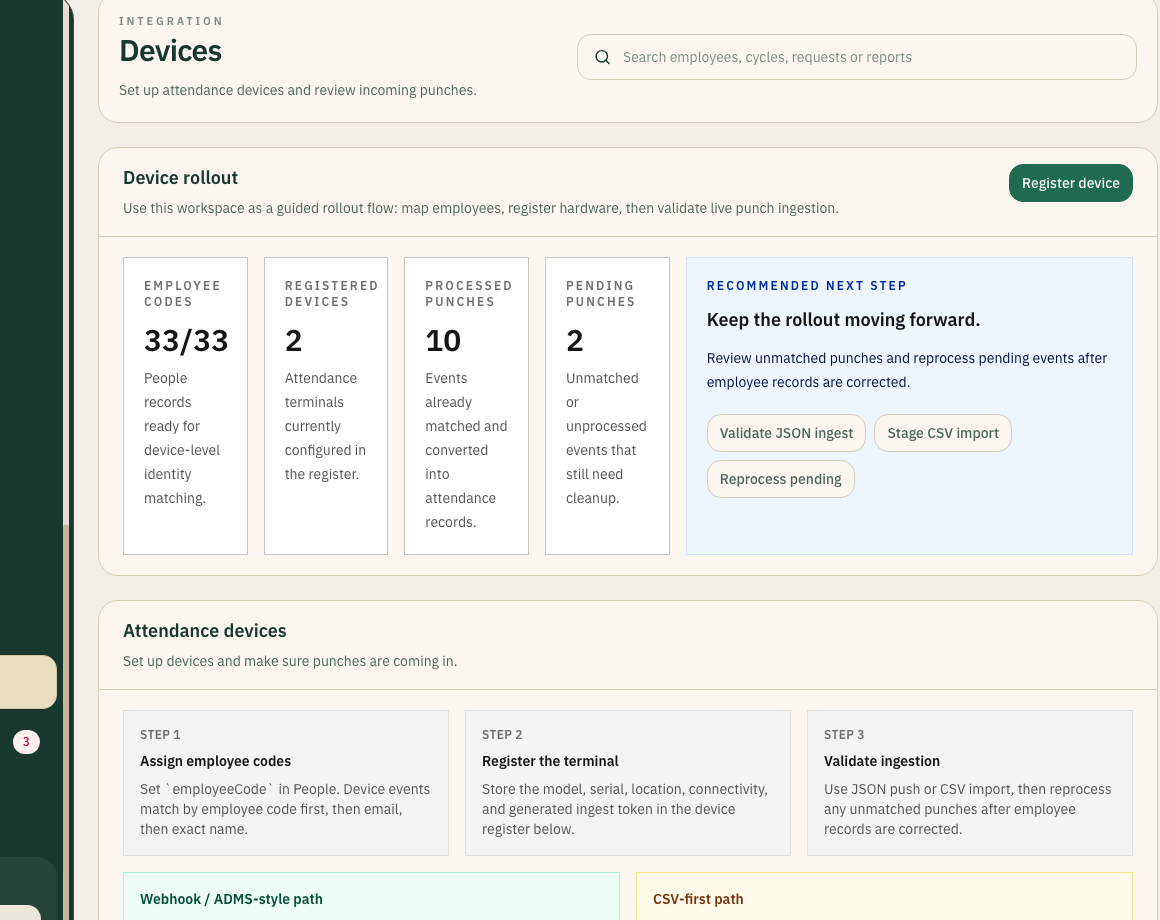
The system provides a rollout path for registering devices, validating ingest, and dealing with pending events.
Inside this view
Visible
Execution state
Owned
Exception flow
The operational problem
Attendance becomes unreliable when every location uses a different process for devices, codes, corrections, and exception review.
How the operating model changes
NxtGenSoftware standardizes attendance operations by bringing devices, employee-code mapping, ingestion, and exception handling into one workflow.
Best suited for
Run device rollout and punch handling with a repeatable process.
Standardize attendanceWorkflow
Register devices and assign rollout ownership by branch.
Map employee codes before relying on terminal data for payroll.
Review pending, unmatched, or invalid punches in a daily queue.
Close exceptions before payroll preparation begins.
Implementation notes
Detail
Show employee code readiness, registered devices, processed punches, and pending events in one screen.
Detail
A structured rollout flow is easier to support and easier to repeat at new branches.
Detail
Pending events are only useful if the people who can resolve them see them.
Next step
If this page matches the problem your team is trying to solve, the next useful move is a structured conversation around rollout and operating fit.
Continue